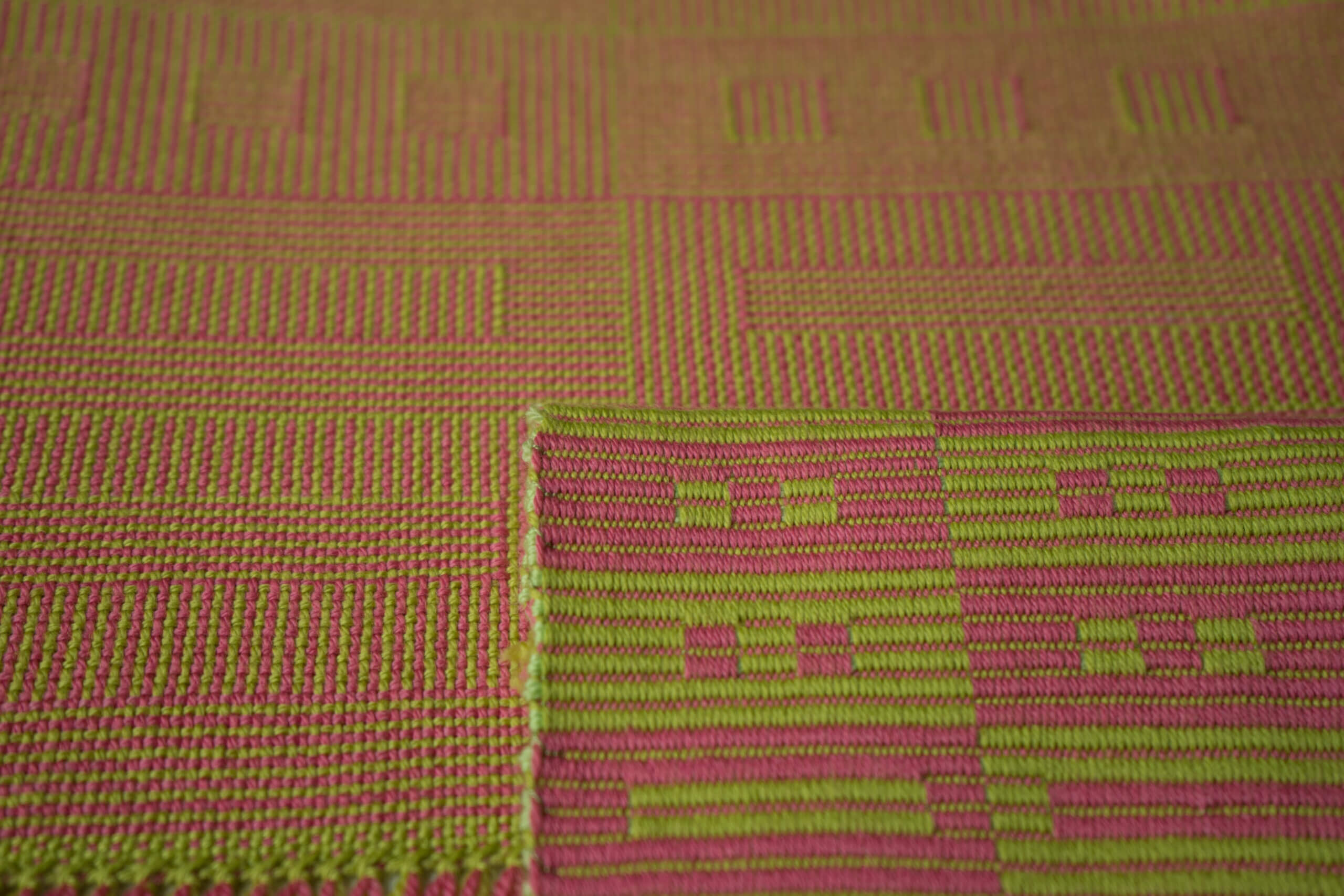
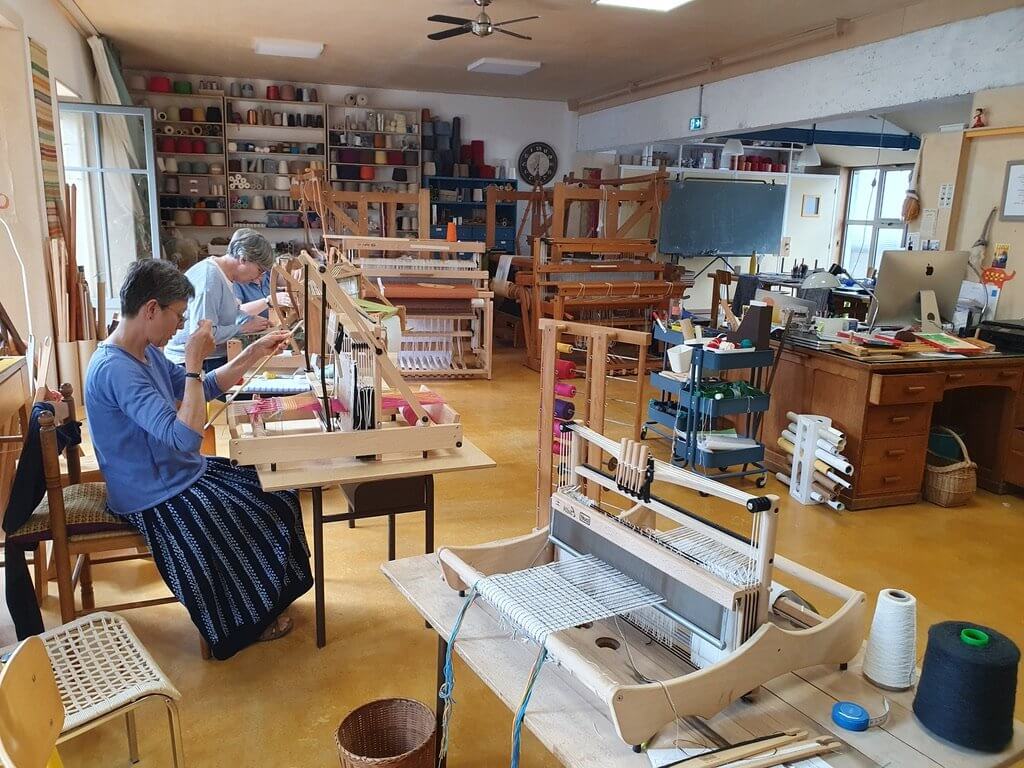
Trainees have access to all the studio’s material and theoretical resources (samples, yarns, looms, accessories, specialized library, etc.). Weaving is done on four, eight, or sixteen-shaft table looms, or on an eight-shaft counter-marche loom upon request and depending on availability.
5-day immersive training
The courses last five days and take place in Chinon, at the ARTissage workshop-school at 8 rue des Marais. Two levels of courses are available:For beginners or refresher courses and advanced courses, where one or more structures are studied according to each student’s choices, defined before the start of the course.
1 – Introduction to artisanal weaving or updating of knowledge
So that technique is no longer an obstacle to the pleasure of creation, this training teaches the basics of weaving, both on a theoretical level, by studying the writing and reading of weaving diagrams and the arrangement of a fabric, and on a technical level, by learning to work with specific equipment: loom, warping frame, threading hook, shuttle…
This training allows you to acquire practical knowledge of weaving or to modify your empirical approach to start again on a good basis. It allows you to discover all the techniques of artisanal weaving in order to put you in a situation of creativity and development of the projects of your choice.
General objectives
- Basic knowledge of weaving and project preparation;
- Setting up the warp on the loom for twill weaving;
- Weaving various samples using different tredling and tie-up;
- In-depth analys of weave structure, and study on weaving finishing techniques;
- Planning the project, validating and developing density assumptions through sampling.
2 – Advanced training in handweaving on a frame loom
The advanced training course is aimed at people who already know how to weave.
It allows participants to review the basics of weaving, or even to supplement their knowledge if necessary, and then to study in great depth a weave of their choice, decided in advance with the instructor.
The weaves that can be studied are: plain weave, twill, satin, summer-winter, overshot, crackle, huck, Bronson, Leno, double weave, deflected double weave, waffle, honeycomb, colour effect, shadow weave, warp or weft reps, Moorman, etc.
General objectives
- Presentation of the weaving structure studied;
- Preparation and installation of the warp on the loom according to the structure studied;
- Weaving of samples;
- In-depth study of the weave;
- Review of what has been learned to master the structure.
Your training requirement must be defined in advance: techniques, desired structures to be studied, models to be analysed. Please do not hesitate to contact us before your course so that we can best meet your requirements.
3 – Woven shibori with indigo and naural colors – 5 days in november 2026
5 DAY WORKSHOP IN WEAVING USING SHIBORI DYING TECHNIQUES WITH INDIGO AND NATURAL COLORS
Over the course of 5 days, explore woven shibori—a fascinating practice where weaving, gathering, and dyeing come together to create the pattern.
Two instructors, Magali Bontoux and Betty Briand, with complementary expertise, will lead two workshops in the same space: weaving and plant-based dyeing.
You’ll experiment with creating resist patterns directly in the weave, indigo dyeing on cotton, madder and woad colors, layering, and pattern variations. A small-group, hands-on workshop designed to help you understand, experiment, and explore new creative avenues.
And that moment we always look forward to: untying the fabric and finally discovering the pattern revealed by the color…
November 9–13, 2026, 5 days / 35 hours. Program and quote available upon request. Professional training and funding options available. Pre-registration form available for download here.

4 workshop in 2027.
Introduction to hand weaving or refresher course
Five days – 35 hours
- From May 31 to June 4, 2027
- From August 2 to August 6 2027
Advanced training in handweaving on frame looms
- From March 1 to March 5 2027
- From July 19 to July 23 2027
Price
€670 + €10 annual membership fee for “Weaving & Cie”
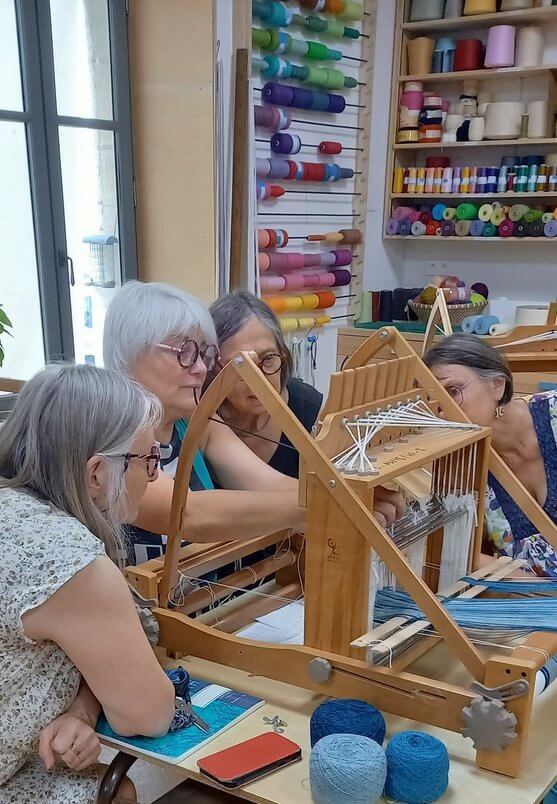
Registration forms can be downloaded here. Please check with ARTissage to ensure there is still space available before sending your registration.
Year-long classes
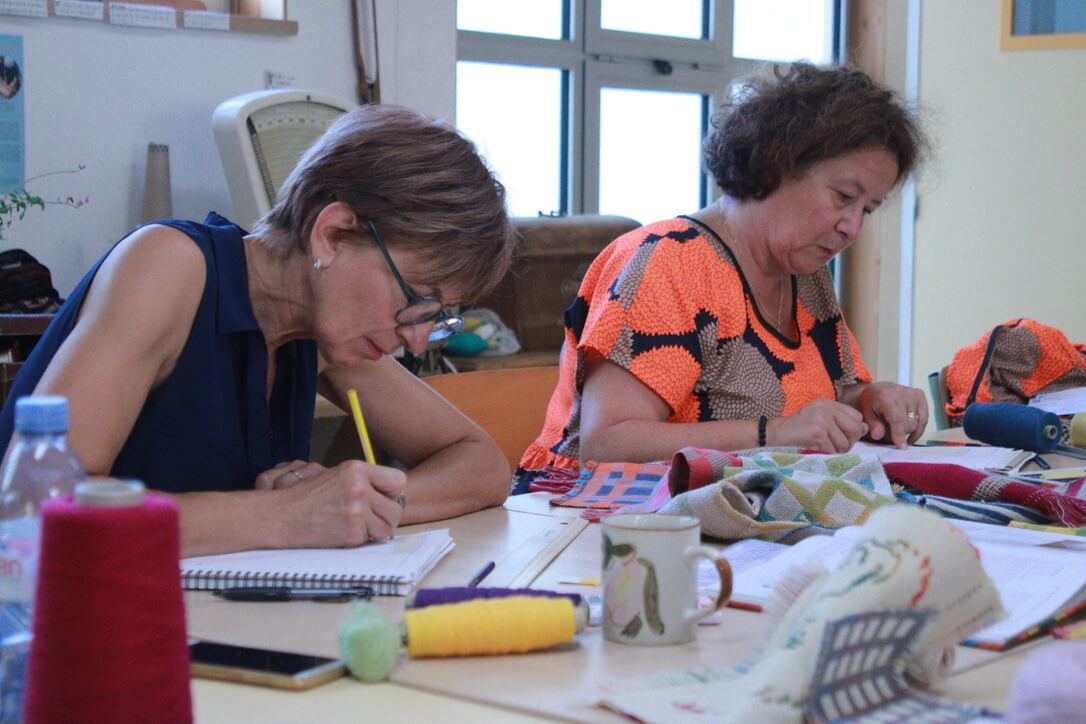
During the workshop, I will help you create your project: making technical choices (choosing the yarns you bring or find on site, choosing the weave, and choosing what is the use of your fabric), setting up the project on the loom (winding the warp, threading the heddles and the reed, tying the treadles), then starting to weave.
You will return home with a loom ready to be use to to carry out the project at your home, and then come back to thestudio for a new project to build together.
The workshops take place in Chinon. Registration is for the entire year. Supplies are not included. If you take the yarn to the studio, then you weigh it, and pay according to the weight and price…
General objectives
- Become self-sufficient in designing a weaving project, setting it up on the loom, and weaving;
- Understand a new weaving structure;
- Prepare the project so you can take home the loom ready to be woven.
2026/27 calender
– Thurstday or Saturday, from 13:30 p.m. to 6h30 p.m..- eight sessions throughtout the year, spread over the school year, 40 hours/year
€546/year + €10 annual membership fee for the “Tissage & Cie”
– Thursday, from 10:00 a.m. to 6:30 p.m. – four sessions per year, spread throughout the school year, 30 hours/year
€408/year + €10 annual membership fee for the “Tissage & Cie”
With a one-hour lunch break possible on site, brought from home
– Thursday, from 10:00 a.m. to 6:30 p.m. – eight sessions per year, spread throughout the school year, 30 hours/year
€819/year + €10 annual membership fee for the “Tissage & Cie”
With a one-hour lunch break possible on site, brought from home
– Saturday, from 13:30 p.m. to 6h30 p.m. – six sessions throughtout the year, spread over the school year, 30 hours/year
€408/year + €10 annual membership fee for the “Tissage & Cie”
– Three weekends per year
September 26 & 27, 2026, January 30 & 31 2027, May 6 & 7, 2027
Saturdays from 10 a.m. to 7 p.m. and Sundays from 9 a.m. to 5 p.m. With a one-hour lunch break possible on site, brought from home – 15 hours/weekend, 45 hours/year
€615/year + €10 annual membership fee for the “Tissage & Cie”
Three “double days” per year, Thursday/Friday
Group 1: October 8 & 9, 2026, January 14 & 15, 2027, May 6 & 7, 2027
Group 2: October 30 & 31, 2026, February 25 & 26, 2027, April 22 & 23, 2027
Thursday from 10 a.m. to 7 p.m. and Friday from 9 a.m. to 5 p.m. With a one-hour lunch break possible on site, brought from home – 15 hours/weekend, 45 hours/year
€615/year + €10 annual membership fee for the “Tissage & Cie”
For all workshops, it is possible to rent a loom for the year with quarterly payments, and take it home between sessions to continue weaving quietly at home: €156/year.
Yarn purchased at the workshop for use in your weaving is not included in these prices.
Prerequisites
- Practice weaving so that you can work independently through the stages of setting up the loom;
- Know how to read and write weaving patterns.
Some details about the workshops:
- Registration is for the entire year, covering the three terms: fall, winter, and spring.
- Payment of a €100 deposit upon registration for leisure training courses;
- A maximum of six people per session for an individualized approach that encourages discussion and inspiration;
- The trainee takes the table loom home to weave between sessions; the fee is €150 for the year. A non-refundable deposit of €600 is required. Thre threads belong to the particpants;
- For all full-day training courses, lunch, brought by each trainee, can be eaten together. A kitchen is available for your use.
- Workshops can be held in locations other than Chinon upon request. Please feel free to contact me: tel: 06 24 97 29 28 – email: betty.briand@free.fr
The confession…
I have to admit something: I’m scared by the amount of theoretical information I have to teach on the first day of my internships! I almost feel sorry for my students. But even so, it seems absolutely necessary to me, I don’t know how else to do it!!!
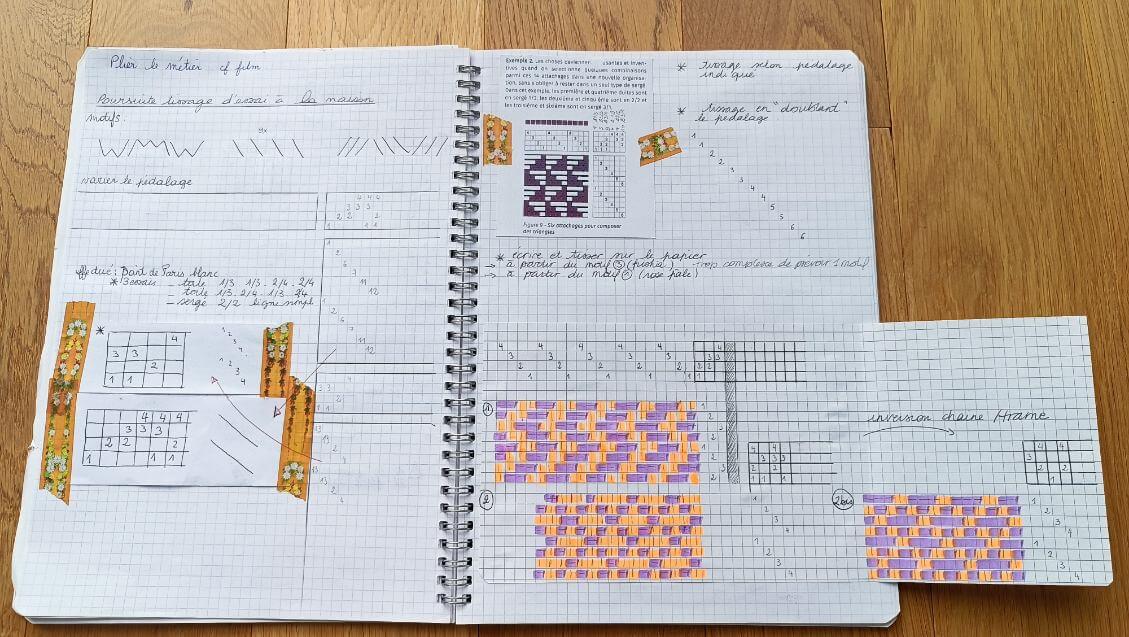
Indeed, it is not just a matter of learning how to weave, which already requires a great deal of knowledge, but also of learning how fabric is made.
Designing your own fabric requires essential theoretical approaches, which means that the first day of the course is, shall we say, a little dense. :=)))
In my workshop, there are no shortcuts, no cutting corners, no loopholes: you have to know how to calculate the density, the number of interlacings, the shrinkage, the quantities of thread required down to the meter, the graphic representation on paper, and you have to know why you choose a particular structure. Weaving is first and foremost about thinking, calculating, and making choices.
But how do weavers react to this theoretical immersion from day one? I asked them this question last summer, and here is a compilation of their answers:
– Sure, it’s intense, but I need to understand before I do it, so that’s fine with me;
– It allows you to refresh your knowledge, revise what you already know, or discover new things;
– It’s great because you understand the practical reason behind certain knowledge, which reassures me;
– I didn’t notice the time passing because it was so captivating;
– Experienced people know that this is how it should be done; beginners are discovering it;
– With this, we know what we’re talking about: it’s training, not just discovery;
– On the first day, our brains are a little overwhelmed, but we have to trust Betty—we have no choice;
– Sometimes, you suddenly understand something small that you had missed, and then everything falls into place like pieces of a puzzle;
– You need a brain to be a craftsman, not just hands and feet;
– Betty succeeded in her challenge to revive weaving by teaching it through theory.
Thank you, that’s kind of you to say. But I recognize that some trainees don’t appreciate the need for so much knowledge before they start weaving. I explain to them that this is how I really got into weaving during my training in Germany, through conceptualization and abstract intellectualization.
I like to use the image of a puzzle to describe the training: each piece of knowledge is a piece of a puzzle that you can put together however you want. And then, what do you start weaving? A Bach concerto or Au clair de la lune? Well, it’s entirely up to you!!! :-)))
Technical appointment
The Technical appointment lasts two or three days and takes place in Chinon
One week-end, one technique!
Two or three days to discover, explore, and experiment with a single technique. Last year, we explored
Deborah Silver’s technique, the split chain.

Alternating between theory and practice, sketch drawing, weaving, individual work, and group discussions.
The weaver arrives with a warp prepared on their loom (looms are provided for those who do not have one, so please bring the warp with you) according to a specific threading that is communicated in advance.
Date et theme to be determined: exploration of Anni Albers’weavings is being considered. Program, date, and details to be determined and annonced at a later date.
A crazy desire: to have Deborah Silver come and explain her divided chain to us.
Due to our already busy schedule, we are unable to plan any events for 2026. If vou are interested in attending, please send me an email